


Skip to content
Open navigation

Better research begins with more than one way of seeing.

Shivam and Soniya bring field and systems understanding together with empirical and methodological depth, then translate both into practical use.

Co-founded in the United KingdomShivam Rawal + Soniya Gupta-Rawal
Soniya Gupta-Rawal and Shivam Rawal together at an event

01

Shivam Rawal

Implementation, measurement, evidence use

02

Soniya Gupta-Rawal

Empirical methods, markets, innovation

Why we built Research Impact Lab

Research can be careful and still fail to travel.

Across classrooms, public systems, research teams, nonprofits, and emerging markets, we kept encountering the same gap. Organisations were generating data and commissioning studies, but the connection between evidence and the next practical decision was often weak.

Research Impact Lab was created to work inside that gap. We help partners begin with the decision they need to make, build evidence that fits the context, and translate what is learned into strategies, tools, systems, and next steps that people can actually use.

We bring methodological rigour, but we do not arrive with a pre-selected method. We listen first, make assumptions visible, and design the work with the people who will generate, interpret, and act on the evidence.

Soniya Gupta-Rawal and Shivam Rawal standing together in front of the Radcliffe Camera in Oxford
Soniya and Shivam in Oxford. Their work combines experience across research, practice, public systems, and emerging markets.

The founders

Different starting points. A shared way of working.

Shivam often begins close to implementation. Soniya often begins with empirical identification. Research Impact Lab brings those perspectives together.

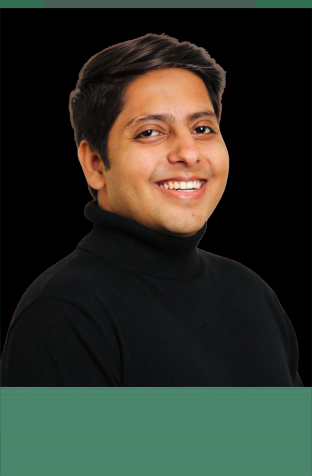
Portrait of Shivam Rawal wearing a black roll-neck sweater

Portrait supplied by the founders.

Co-founder

Shivam Rawal

Measurement, evaluation, education systems, and evidence use.

Shivam Rawal is an education research, measurement, evaluation, and evidence-use specialist with more than eight years of experience across India, Sub-Saharan Africa, the United Kingdom, and the United States. He works at the point where technical design meets delivery: helping partners shape studies, improve measurement, develop curricula and assessments, interpret evidence, and translate findings into programme and funding decisions.

Shivam began his career as a Teach For India Fellow, teaching mathematics in a low-resource school in Delhi. He later worked with Educational Initiatives and Central Square Foundation on assessment, structured pedagogy, teacher development, and large-scale foundational learning programmes. As a Fulbright-Nehru Scholar at Columbia University, and later through policy implementation work in Washington, DC, he deepened his understanding of how evidence, finance, policy, and delivery interact across education systems.
Areas of expertise

  • Education measurement
  • Assessment design
  • Programme evaluation
  • Mixed-methods research
  • Monitoring, evaluation, and learning
  • Research-to-practice translation
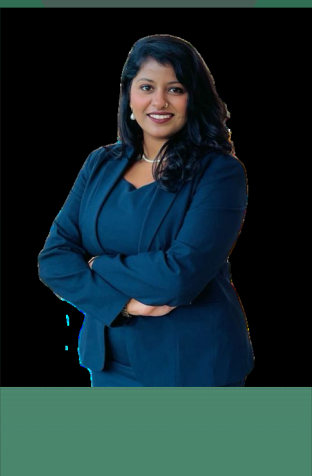
Portrait of Soniya Gupta-Rawal wearing a navy suit

Portrait supplied by the founders.

Co-founder

Soniya Gupta-Rawal

Quantitative research, field experiments, emerging markets, and AI-enabled tools.

Soniya Gupta-Rawal is a quantitative marketing researcher at Cambridge Judge Business School studying how informational, social, and institutional constraints shape decisions for entrepreneurs, firms, and consumers in emerging markets. Her work focuses particularly on micro-entrepreneurs, women-led businesses, informal retail, digital adoption, and frugal innovation.

Working across India, Indonesia, Egypt, and Sub-Saharan Africa, Soniya uses field experiments, causal inference, econometric analysis, AI-enabled tools, remote-sensing data, and grounded field partnerships to examine what works, for whom, and why. She holds an MPhil in Strategy, Marketing and Operations from the University of Cambridge, completed as a Commonwealth Scholar.

Areas of expertise

  • Quantitative research
  • Field experiments
  • Causal inference
  • Econometric analysis
  • AI-enabled research tools
  • Entrepreneurship and market systems

How the perspectives combine

Rigour is stronger when it stays close to context and use.

01

Field and systems understanding

We pay attention to how programmes are delivered, how people experience them, and what organisational or system conditions shape results.

02

Empirical and methodological depth

We select methods that can answer the question credibly, from qualitative inquiry and measurement design to field experiments and econometric analysis.

03

Translation into use

We design outputs around what partners need to decide, communicate, improve, fund, test, or scale next.

Selected education and experience

Experience shaped across research, practice, and public systems.

These are selected parts of the founders' individual journeys. They are not presented as Research Impact Lab clients.

Shivam Rawal

  1. 01MA in Economics and Education, Teachers College, Columbia University
  2. 02Fulbright-Nehru Master's Fellow
  3. 03Teach For India Fellow
  4. 04Education Pioneers Fellow
  5. 05J-PAL/MITx training in randomised evaluations

Soniya Gupta-Rawal

  1. 01Doctoral research, Cambridge Judge Business School
  2. 02MPhil in Strategy, Marketing and Operations, University of Cambridge
  3. 03Commonwealth Scholar
  4. 04Research grants from Cambridge and PEDL/CEPR
  5. 05Research and knowledge consulting experience at EY

A working journey

The work behind the biographies.

Careers rarely move in a straight line. These selected posts capture some of the questions, field experiences, milestones, collaborations, and lessons that shaped Research Impact Lab.

01 / 15

Working principles

What partners can expect from us.

01

Rigour without theatre

We make the logic, assumptions, methods, and limitations visible. Complexity should be justified by the question, not performed for its own sake.

02

Context before templates

We adapt the design to the setting, the people involved, and the constraints under which evidence will be generated and used.

03

Collaboration throughout

Partners are not recipients of a finished report. We involve the people closest to the work in questions, interpretation, and next steps.

04

Evidence for use

We design outputs around what someone needs to decide, improve, communicate, fund, test, or scale next.

Work with the founders

Bring us the decision you are trying to make.

Start a conversation